
How to Check Criminal History in Karnes County
Begin by naming the record you need. The official Karnes Tyler Public Access portal is the first stop for filed county and district cases. It does not replace a police report, booking entry, statewide rap sheet, or fingerprint review. Bring a full name, birth date when lawfully available, spelling variants, an incident or case number, and an approximate date. A name alone can point to the wrong person, so compare the court, charge, filing date, and case status before relying on a result.
Karnes County uses a clear source chain: arresting agency → county jail → prosecutor → court clerk → Texas DPS. Each point creates a different criminal record. Follow that chain instead of treating a blank screen as proof that no record exists.
- Choose the source. Use the District Clerk for felonies, County Clerk for Class A or B misdemeanors and appealed Class C cases, and the issuing city or justice court for an original Class C matter.
- Try the official Karnes Tyler portal with a name or case number. Narrow by court, case type, or filing date when those controls are available.
- Match the result through several public facts. Similar names and automatic expanded searches can produce false matches.
- Ask the right clerk for the docket, judgment, or certified copy. For an incident report or booking sheet, contact the agency that made the record.
- Use the Texas DPS name search for public statewide conviction and deferred-adjudication data. Review your own full Texas history through FAST fingerprints.
Why Karnes County Has Three Record Counters
Karnes County criminal records are split by level and location. Felony files sit with the District Clerk inside the courthouse. The County Clerk keeps Class A and B misdemeanor files and Class C appeals at its West Calvert office. Booking and current custody records belong to the Sheriff's Office and jail on East Wall Street. The split matters before a trip because these counters are not in one criminal justice center.
District Clerk
101 N. Panna Maria Ave., Suite 104
Karnes City, TX 78118
830-780-2562 or 830-780-3065
County Clerk
210 W. Calvert, Suite 100
Karnes City, TX 78118
830-780-3938
Sheriff and Jail
500 E. Wall Street
Karnes City, TX 78118
830-780-3931
The County Clerk posts weekday hours from 8 a.m. to 5 p.m., closes from noon to 1 p.m., and closes registers and doors at 4:45 p.m. The District Clerk posts separate morning and afternoon counter hours. Call the custodian before travel if accessibility help, an interpreter, or an older file is needed.
Official Texas Background Checks
Texas Department of Public Safety Crime Records Services holds the Computerized Criminal History system. Its public name product chiefly returns convictions and deferred adjudications reported by Texas agencies. It is not the same as a complete personal record review. For your own criminal history, fingerprints resolve identity far better than a name and date of birth, especially when people have similar names or a local disposition has not matched the arrest cycle. The Texas DPS public name-search page shows the official statewide entry point.
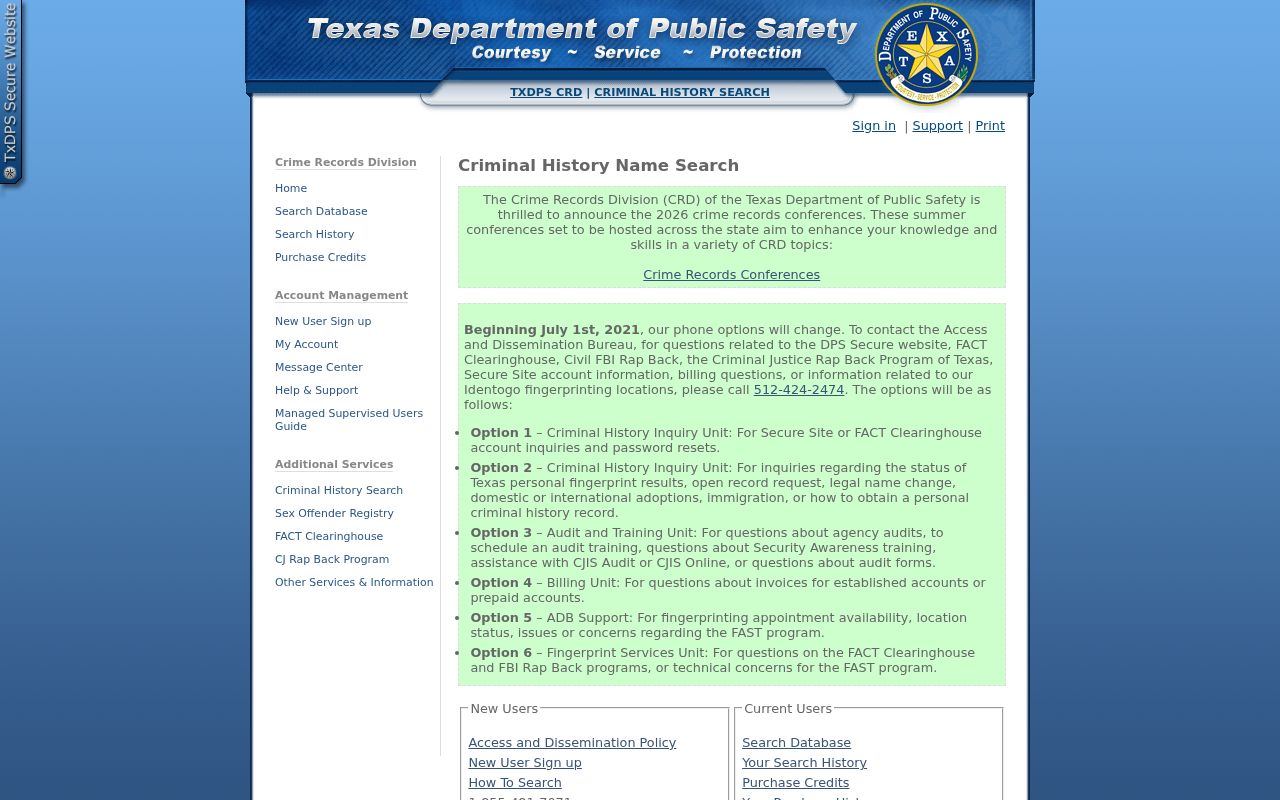
The screen leads public users to account and credit options, while Karnes County case papers still come from the local clerk that holds the file.
| Official route | Current stated charge | Best use |
|---|---|---|
| DPS public online name search | One $1 credit for the initial search | Public Texas conviction and deferred-adjudication data |
| DPS offline name check | $10 | Official name-based request |
| DPS fingerprint check | $15 DPS fee plus $10 FAST fee | Reviewing your own fingerprint-matched Texas history |
| FAST hard cards | $20 for two cards | Processes that require hard fingerprint cards |
The IdentoGO FAST enrollment screen handles appointment and service selection.
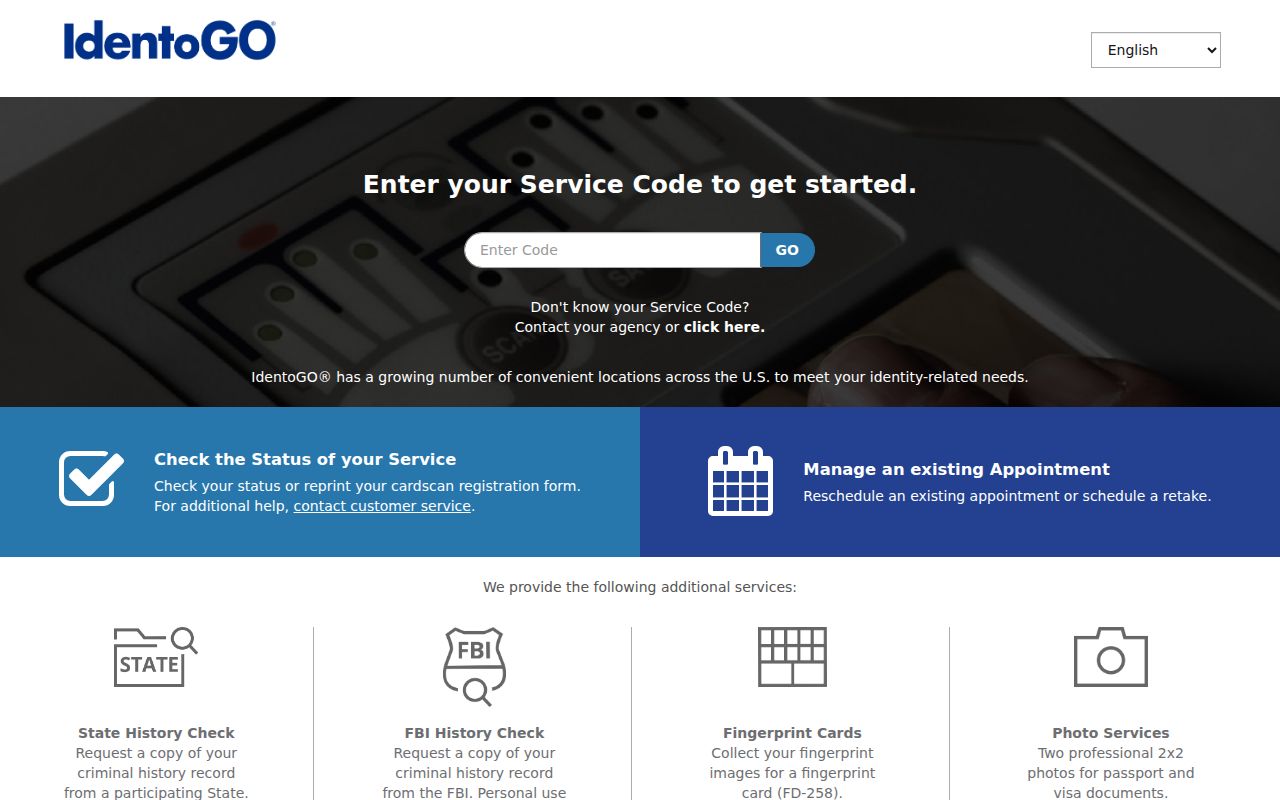
Use a supplied service code only for its stated purpose, bring acceptable identification, and confirm the fee shown during the live enrollment process.
Karnes County Criminal Case Portal
The Karnes Tyler Public Access portal covers case records filed in the county's participating courts. The official County Clerk page directs misdemeanor payors there to identify the case number and judge, then tells them to call the clerk before sending payment. That small detail shows the portal's proper role: it can locate a case, but the custodian must confirm the file, payment office, copy method, and current status.
| Search control | Use | Important limit |
|---|---|---|
| Name | Find a party when no case number is known | Exact live labels were unavailable during the research check |
| Case number | Reach a known file directly | The county confirms this lookup route |
| Court or location | Narrow county versus district results | Available values must be checked in the live portal |
| Case type | Limit the result set to criminal matters | Enabled categories can vary |
| Date filed | Reduce common-name results | Use a range when that control appears |
If the automated page returns an access error, use a normal browser, try re:SearchTX as a statewide supplement, then contact the County Clerk or District Clerk. The statewide platform does not merge police reports, jail intake, municipal citations, or the full Texas DPS criminal history repository.
Types of Criminal Records
A Karnes County criminal history can span several records that never appear in one database. Police or deputies write the incident report. The jail creates the booking entry. Prosecutors file an information or seek an indictment. Clerks maintain the case docket, orders, judgment, sentence, costs, and warrant events. Texas DPS then attaches qualifying reports to a statewide arrest cycle when local submissions match.
- Incident and arrest reports describe the call, alleged conduct, officers, evidence, and enforcement action, subject to redaction.
- Booking records document intake, booked charges, holds, bond, custody status, and release or transfer.
- Court case files show filed charges, hearings, pleas, motions, disposition, judgment, sentence, and financial entries.
- Texas CCH records join fingerprint-supported arrest events with prosecutor, court, custody, and supervision reports.
- Warrant and supervision records come from the issuing court, law enforcement, community supervision office, parole authority, or filed court motions.
Original municipal and justice-court Class C records stay local unless appealed. Federal cases are separate again. The Karnes County criminal court case records provide more detail about charges after filing.
Karnes County Custody Records After Booking
The Karnes County Sheriff's Office links VINELink for local custody status instead of publishing a county-hosted jail roster with verified field definitions. The 50-bed county jail is at 500 E. Wall Street. It must not be confused with private or federal immigration detention facilities that also appear in news under the Karnes name. For a current booking, check VINELink, call the Sheriff's Office, identify the arresting agency, and ask that agency for its incident or arrest report.
For an older booking that no longer appears, submit a narrow written Texas Public Information Act request for the existing booking sheet. Then check the proper clerk for the later charge and disposition. State prison custody is different. The TDCJ Online Inmate Search accepts a name, TDCJ number, or state identification number.
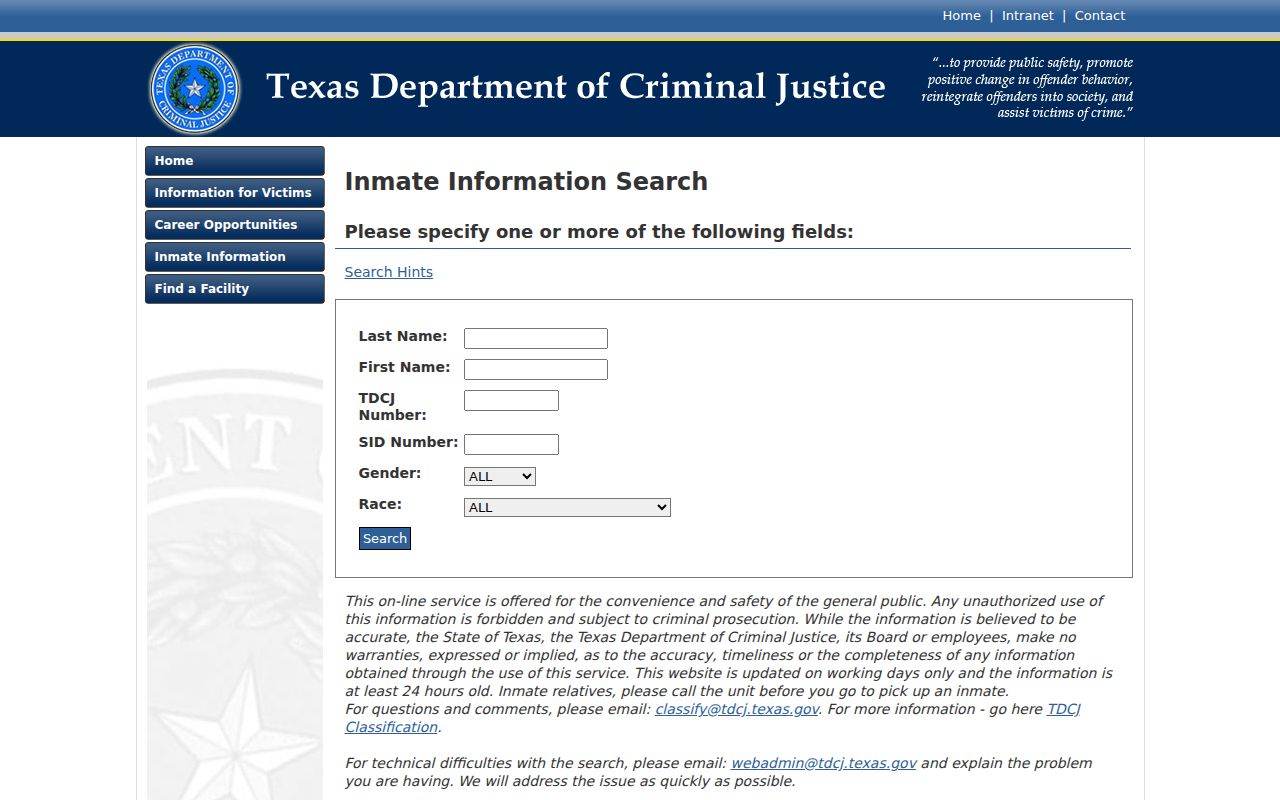
TDCJ results may show state location, offense, projected release, and parole data. They do not answer whether someone is now booked in the Karnes County Jail. A fuller local booking route appears with the county's official arrest history channels.
What a Karnes County Criminal Record Shows
Read the product label before reading the fields. A public Texas DPS name result, a Karnes County court file, and a jail booking record contain overlapping names and charges, but each represents a different stage. Public views also suppress full Social Security numbers, account data, exact victim or minor identifiers, and content covered by a sealing, expunction, or nondisclosure order.
| Name & identifiers | Names, aliases, date of birth, sex, race, and agency identifiers where the law and product allow. |
|---|---|
| Arrest & booking | Arrest date, agency, tracking or booking number, charges at intake, warrants, bond, and release or transfer. |
| Charges & statutes | The alleged offense, statute, degree or class, and later prosecutor filing when available. |
| Disposition | Pending, conviction, dismissal, acquittal, deferred adjudication, or another final result. |
| Sentence | Confinement, fine, community supervision, restitution, costs, and related orders. |
| Custody or supervision | County custody, TDCJ location, release status, community supervision, or parole, depending on the source. |
A booked charge may be rejected, changed, enhanced, or dismissed. A dismissal ends a charge but does not erase the arrest by itself. Likewise, a portal status of disposed means the case ended, not that the result was a conviction.
Correcting Karnes County Criminal History Errors
A missing disposition often means the local court outcome has not yet matched the arrest cycle in Texas DPS records. First, review your own fingerprint-supported CCH and identify the exact event. Then ask the Karnes County clerk that owns the case for a certified disposition. The County Clerk handles its misdemeanor docket, while the District Clerk handles felony district cases. Send the court proof with the required error-resolution material to DPS rather than asking the portal vendor to alter the underlying record.
The Texas DPS Error Resolution Unit instructions explain that correction path.
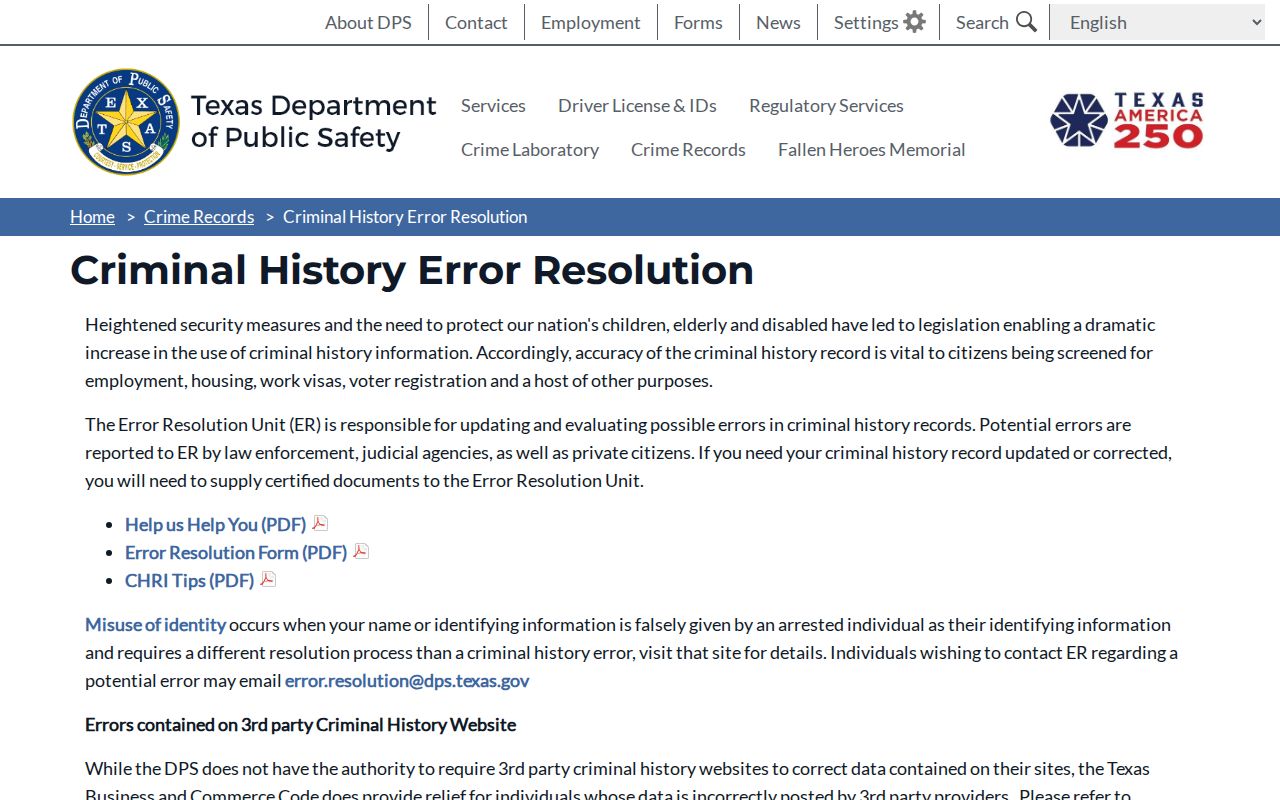
The process addresses repository accuracy. It is not expunction, and it does not change a correct court result merely because that result is unfavorable. If the clerk's file itself is wrong, start with that clerk because DPS depends on the agency report.
Note: A blank Karnes County portal result is not proof of a clean record, especially when an older case or unmatched disposition may exist.
Public Access Laws
The Texas Public Information Act governs many records held by the sheriff, county, and city agencies. It requires a request for existing information, not answers to questions or new research. Karnes County accepts its county-wide request form by email at public.records@co.karnes.tx.us or through the County Attorney at 101 N. Panna Maria Avenue, Suite 302. The county states that it will respond within ten business days, though clarification, cost estimates, redaction, or an attorney-general decision can lengthen production.
Key Texas authorities:
Government Code Chapter 552 gives the public a route to government-held information and allows specified law-enforcement exceptions while preserving basic offense and arrest facts.
Government Code Chapter 411 limits criminal-history dissemination but makes reported conviction and deferred-adjudication data available through the public DPS product.
Code of Criminal Procedure Chapter 55A governs expunction and closes retained expunction files from ordinary public inspection.
Texas Rules of Judicial Administration distinguish administrative judicial records from ordinary court case files, which remain with the proper clerk.
Active-investigation details, juvenile material, victim information, protected personal data, and sealed records may be withheld or redacted. The County Clerk requires a written criminal-record request and prepayment. It does not conduct searches by phone and warns that documents are returned by fax or regular mail rather than email.
Karnes County Criminal Reporting Lag
A January 2026 DPS completeness report counted 26 Karnes County DWI charge events for 2024, 24 prosecution events, and 10 court-action events. Those figures are not a crime count and do not rank local safety. They measure how the linked reporting steps reached the state system. The gap is useful because it shows why a recent court result may trail the arrest or charge in statewide criminal history data.
The Texas Uniform Crime Reporting program explains the state's official crime-data framework.
Karnes County searchers should treat statistics, court indexes, and repository results as different products. If a disposition is absent, check the clerk's judgment first. If the judgment exists, use that certified record in the DPS correction process.
Sealed, Expunged & Restricted
Texas expunction and an order of nondisclosure are not the same. An expunction under Chapter 55A can require covered arrest and court references to be removed or destroyed. Nondisclosure restricts ordinary public dissemination but preserves access for listed government and criminal-justice entities. Juvenile records follow separate confidentiality and sealing rules. An investigative redaction is narrower still because public parts of the record may remain.
- Expunction
- A Texas remedy that can remove covered records when the exact statutory conditions are met.
- Nondisclosure
- An order that limits public release without destroying the record or blocking every authorized recipient.
- Dismissal
- The end of a charge without a guilty judgment. It does not erase an arrest automatically.
- Deferred adjudication
- Community supervision while a court delays a guilt finding after a plea. Completion does not make the record vanish.
The Texas DPS record-clearing overview separates expunction, nondisclosure, and juvenile sealing.
Karnes County does not publish a local expunction packet or fee. Get the full file, identify each arresting and reporting agency, confirm the current law and waiting rules, then ask the District Clerk about the correct filing route. Relief should be verified later in both the clerk system and your personal DPS review.
Karnes County Warrant Record Chain
No official Karnes County active-warrant list, online search, or sheriff app was verified. That absence does not mean no warrant exists. For a concern about your own record, call the Sheriff's Office about execution status, then contact the issuing court. The District Clerk handles felony warrants and capias entries, the County Clerk handles county misdemeanors, and each municipal or justice court controls its own bench warrants and Class C matters.
A written public-information request can seek an existing warrant record, but the response is not real-time clearance. Sealed and juvenile warrants will not be public. Karnes County Crime Stoppers is an anonymous tip line, not a warrant-check line.
If a warrant appears, confirm the case number, warrant type, appearance instructions, and bond status with the issuing court. Legal counsel may be needed when liberty is at risk. Do not assume that a payment alone recalls a warrant, and verify that both the court and law-enforcement databases show the later recall.
Criminal Records by City in Karnes County
City records add the first layer for police incidents, citations, and original municipal matters. Kenedy has its own police-report request path and municipal citation portal. Karnes City accepts police-record requests and maintains a fine-only municipal docket. Runge has no verified police portal or municipal court listing, so its practical route begins with Justice of the Peace Precinct 4 and the county sheriff. Custodial arrests from all three cities route to the Karnes County jail, while higher charges move to the county or district clerk.
Kenedy Criminal History
Population 3,473 · Police records through the City Secretary and citations through Kenedy Municipal Court.
Karnes City Criminal History
Population 3,111 · City police reports and municipal Class C records use separate local channels.
Runge Criminal History
Population 892 · Start with JP Precinct 4 for fine-only matters and the sheriff for custody records.
The city rank uses the official 2020 Census count. A city portal result is not a full Karnes County criminal history because felony, county misdemeanor, jail, and state repository data remain with other custodians.
Karnes County Supervision Records
Texas calls probation community supervision. Karnes County participates in the 81st and 218th Judicial District Community Supervision and Corrections Department structure, while juvenile probation is separate. A court judgment and filed motion to revoke or adjudicate may be public, but internal supervision notes are not assumed public. For local status, compare the sentencing order with the adult probation office rather than reading a jail release as proof that supervision ended.
Parole is different. The Texas Board of Pardons and Paroles makes release decisions, and the TDCJ Parole Division supervises release. Karnes County is assigned to the Seguin District Parole Office. The Texas parole authority page identifies the board's role and status resources.
A TDCJ result can show state custody or parole information, while a Karnes County case file shows the sentence and later filed proceedings. Use both when a record uses the broad word supervised, since it may refer to community supervision or parole.