
Running a Sex Offender Check in Karnes County
The Texas Public Sex Offender Registry is the primary public source for a Karnes County sex offender check. Texas DPS manages the statewide portal from data supplied by local registration authorities. It supports searches tied to a name or place, as well as location, route, and proximity modes. Start with the most reliable fact already known. A full name helps when checking a person, while an address or other location is more useful for neighborhood awareness. Open the whole profile before drawing a conclusion from a results row.
Karnes County does not publish a separate sheriff registry map in the inspected material. That makes the DPS record the main public view, while the local office remains the best channel for a question about where a person registers or how to report suspected noncompliance. A name match alone is not enough to identify someone. Compare the photo, aliases, physical details, address description, conviction facts, and registering agency. Do not seek fingerprints, victim names, phone numbers, or other fields Texas keeps from the public profile.
Karnes County Registry Channels
The registration office depends on the residence. A person living inside a municipality generally registers with that city's law-enforcement agency. Someone outside a municipality uses the Karnes County Sheriff's Office. Those channels send registry information to DPS, which then supplies the statewide public view. This split matters when a Karnes County offender record appears stale or the public needs to report a possible failure to update.
County and Rural Addresses
Karnes County Sheriff's Office
500 E. Wall Street
Karnes City, TX 78118
Registry directory: 830-780-3934
County main: 830-780-3931
Municipal Addresses
Karnes City Police
1007 N. Highway 123
830-780-2300
Kenedy Police
303 W. Main Street
830-583-2230
Runge needs special care. No Runge police agency appeared in the approved registration-agency material reviewed for Karnes County. A Runge resident should call the sheriff's registration number and confirm the correct office instead of assuming that a city counter exists. Specific registry counter hours and fees were not published, so call before making a trip.
Note: Use 911 for an immediate threat; use the local registration authority for a nonemergency report of suspected registration noncompliance.
Searching the Texas Public Sex Offender Registry
DPS runs the official Texas registry. The live interface was not readable enough during research to confirm which fields are mandatory, so required-field claims should not be guessed. Official DPS material does confirm name, address or location, route, and proximity search modes. For a Karnes County registry search, choose the mode that fits the safety question and use the result list to reach the detailed state profile.
- Open the DPS public registry and review its conditions of use.
- Choose a name, address or location, route, or proximity search.
- Review possible results and compare enough facts to avoid a similar-name error.
- Open the full profile and check the offense, address, risk, status, and reporting agency.
| Field Label | Type | Required | Notes |
|---|---|---|---|
| Name | Text search | Not confirmed | Use known identity details and compare the full profile. |
| Address or Location | Place search | Not confirmed | Supports checks centered on a known place. |
| Route | Route search | Not confirmed | Official DPS material confirms a route-based mode. |
| Proximity | Map or distance search | Not confirmed | Looks near a point; do not infer a statewide buffer rule. |
The official DPS registry search screen shows the public starting point without centering attention on any private person.
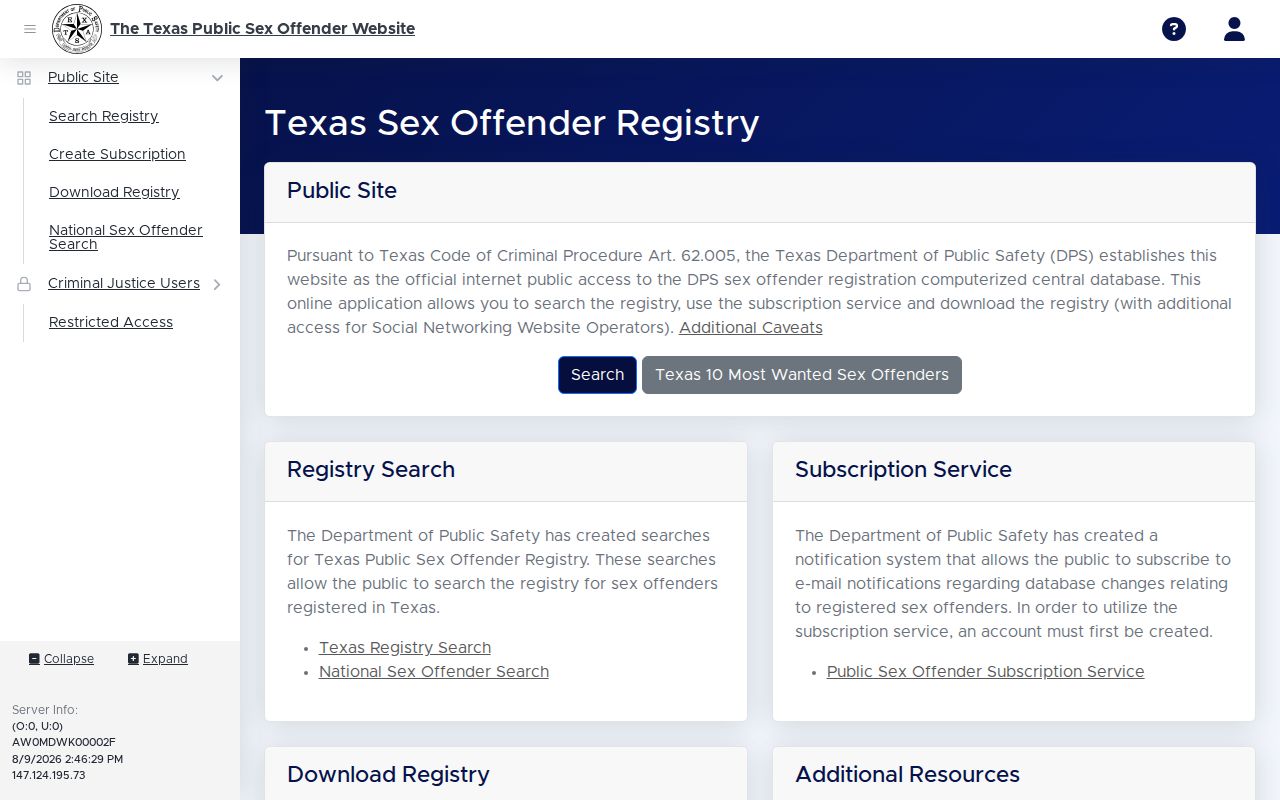
Its mode choices help a Karnes County reader move from a broad safety question to a defined name, place, route, or nearby area.
Karnes County Registry App Searches
The Texas DPS mobile app adds a practical route for the search modes documented by the state. A proximity check asks who appears near a point. A route check follows a path instead. These tools can support a plan for a walk, trip, or routine drive in Karnes County, while a name search answers a different question about one possible identity.
Each app result still needs review at the profile level. Compare the photo, address facts, offense, and registration agency just as carefully as a result found through the DPS web portal.
Karnes County Registry Distance Rules
A map pin is not a legal boundary. Texas Code of Criminal Procedure Chapter 62 does not itself impose one statewide school or park distance rule. A supervision term or local ordinance may create a child-safety zone in a given case, but the registry's proximity display does not prove that a person violates one.
Use the app and web portal as public-awareness tools, not as substitutes for the order, ordinance, or registration authority that governs a specific duty. The right local office can address a real compliance concern without guesswork or personal contact.
What a Registry Profile Shows
A Karnes County sex offender profile combines identity, location, offense, and registration facts that DPS is allowed to show. It may include details collected by the state and the local updating agency, but it is not a full police file or court case. The public record is built for awareness. It deliberately excludes several personal identifiers and protected facts.
| Name & Aliases | Registered name plus known aliases; date of birth may help separate similar names. |
|---|---|
| Photo & Physical Description | Recent color photo, sex, race, height, weight, eye and hair color, and shoe size. |
| Registered Address | Residence or an address description reported through the registration process. |
| Offense & Case Facts | Reportable offense, victim age, conviction date, punishment, and custody or supervision status. |
| Risk Level | Texas assessment of low, moderate, or high danger, which is not a federal SORNA tier. |
| Registration Activity | Registering or updating agency and event, with other status facts supplied by DPS. |
Some collected facts stay outside the Karnes County public profile. DPS does not publicly present Social Security numbers, driver's-license numbers, phone numbers, online identifiers, employer details, victim identity, protected juvenile information, or extra DPS-only fields. Fingerprints are collected for the official record but are not claimed as a public display field. Vehicle data can appear for specified trafficking convictions, and higher-education information may also be present where applicable.
Karnes County Offender Checks Beyond Texas
The National Sex Offender Public Website, or NSOPW, is the U.S. Department of Justice layer for a search that crosses state and tribal registry lines. It accepts first and last name searches or as many as five ZIP codes, with optional county, city, and jurisdiction scope. Its address-radius search uses an address, city, state, and distance. Result headings include offender, age, aliases, and address.
NSOPW is helpful when someone recently moved to Karnes County or when a name search may involve another state. It does not replace the DPS source for a Texas registration question. Use NSOPW to find the relevant jurisdiction, then read the linked official profile and contact the authority named there when a status needs confirmation.
The official NSOPW search interface shows the national query route without republishing any registrant's personal details.
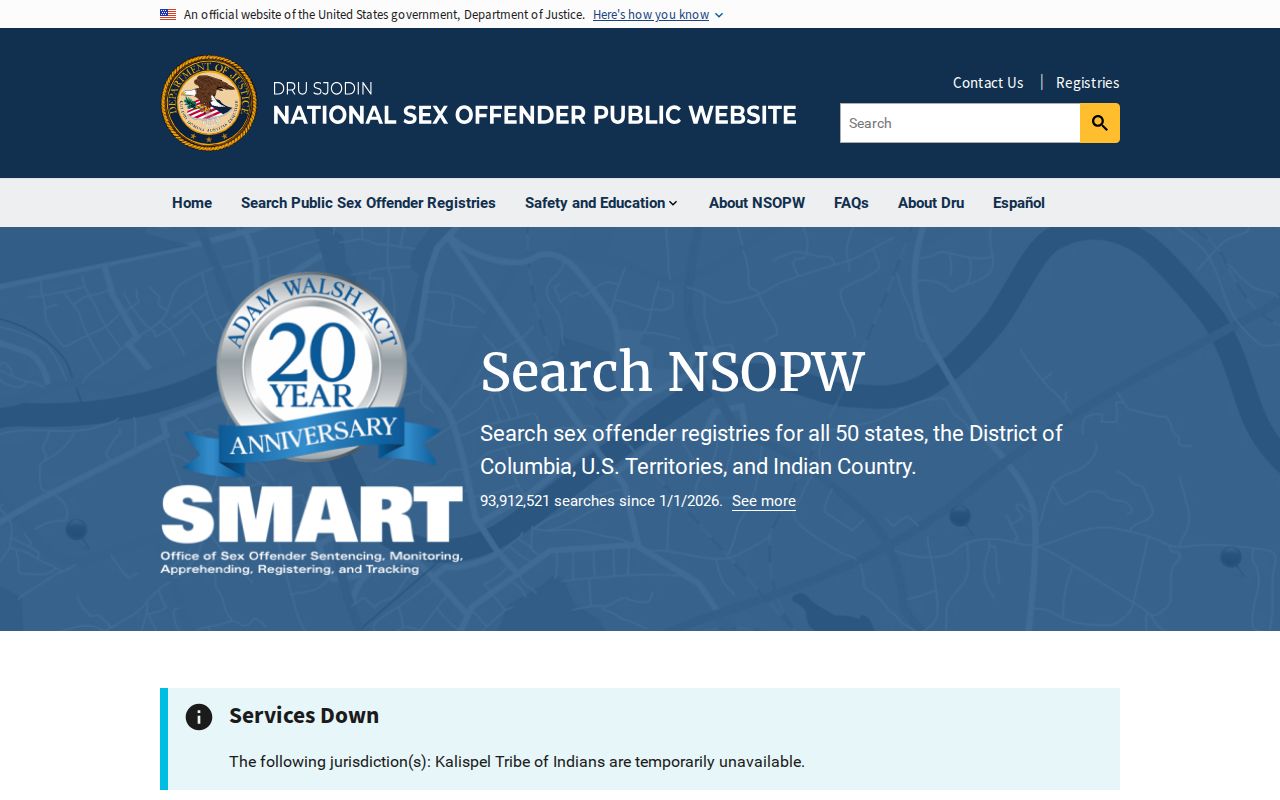
That extra jurisdiction layer is most useful when a Karnes County search cannot be resolved within the Texas registry alone.
Registration Requirements and Levels in Texas
Texas separates risk from the length of the registration duty. Adults generally register for ten years after discharge from incarceration, parole, or community supervision, or for life, depending on the reportable offense and statutory history under Code of Criminal Procedure Chapter 62. A Level 1 finding does not by itself mean a ten-year term, and Level 3 does not itself create a lifetime term. Federal SORNA tiers also do not set the Texas duty.
| Texas Level or Status | Duration | Verification Frequency |
|---|---|---|
| Level 1, low | Offense-based: ten years or life | Usually annual unless another statutory status controls |
| Level 2, moderate | Offense-based: ten years or life | Usually annual unless another statutory status controls |
| Level 3, high | Offense-based: ten years or life | Usually annual unless multiple sexually violent offenses apply |
| Civil commitment | Controlled by the applicable statutory and court process | Every 30 days |
Lifetime categories include specified child-contact offenses, sexual assault or aggravated sexual assault, child-performance offenses, sexually motivated kidnapping, qualifying burglary, prohibited conduct, compelling prostitution, repeat reportable convictions, and substantially similar out-of-state offenses. A full duration answer therefore comes from the qualifying offense and record, not the color or risk label shown on a map.
Karnes County Offender Verification Calendar
A registrant's verification schedule depends on statutory status. A person under civil commitment verifies every 30 days. Someone with two or more sexually violent offenses verifies every 90 days. Other registrants generally verify once each year. These deadlines are different from the ten-year or lifetime duration of the full registration duty and from the Level 1, Level 2, or Level 3 risk finding.
Moves bring another timeline. An intended in-state address change must be reported in person by the seventh day before the move, followed by notice to the new authority within seven days after arrival. Local police handle this process inside Karnes City or Kenedy. The Karnes County Sheriff's Office is the rural channel and the fallback for Runge when the correct approved agency is unclear. Failure to comply is a felony under Article 62.102, so a suspected lapse should be sent to the registration authority rather than tested through personal contact.
Note: A public profile is a current official lead, but the named registration office is the proper place to verify a suspected reporting lapse.
Lawful Use and Community Notification
Karnes County registry information supports awareness and practical safety plans. Texas adds direct community notice for a person assessed at high risk or placed under civil commitment. Notice goes in English and Spanish within one mile in an area that is not subdivided, or within three blocks in a subdivided area. A local authority may also publish notice. Those rules explain why a neighbor may receive a postcard even though the statewide portal remains open to all.
Use the record to plan and to choose an official reporting channel. Do not confront a registrant, household member, or neighbor. A possible failure to register belongs with Karnes County law enforcement, and an emergency belongs with 911. The research found no special Texas crime that broadly makes all misuse of registry data an offense, so that claim should not be made. Ordinary criminal laws still apply to conduct aimed at any person.
Use registry data lawfully: Texas did not yield a special general-user registry-misuse offense in the reviewed sources. Conduct may still violate ordinary laws on harassment, stalking, terroristic threat, or assault. Never threaten, harass, stalk, harm, or try to drive action through confrontation.
The safest response is simple: save the official profile reference, note the fact that appears inconsistent, and contact the authority shown on the record or the relevant Karnes County registration office. That approach lets trained staff compare restricted records that the public cannot see.